

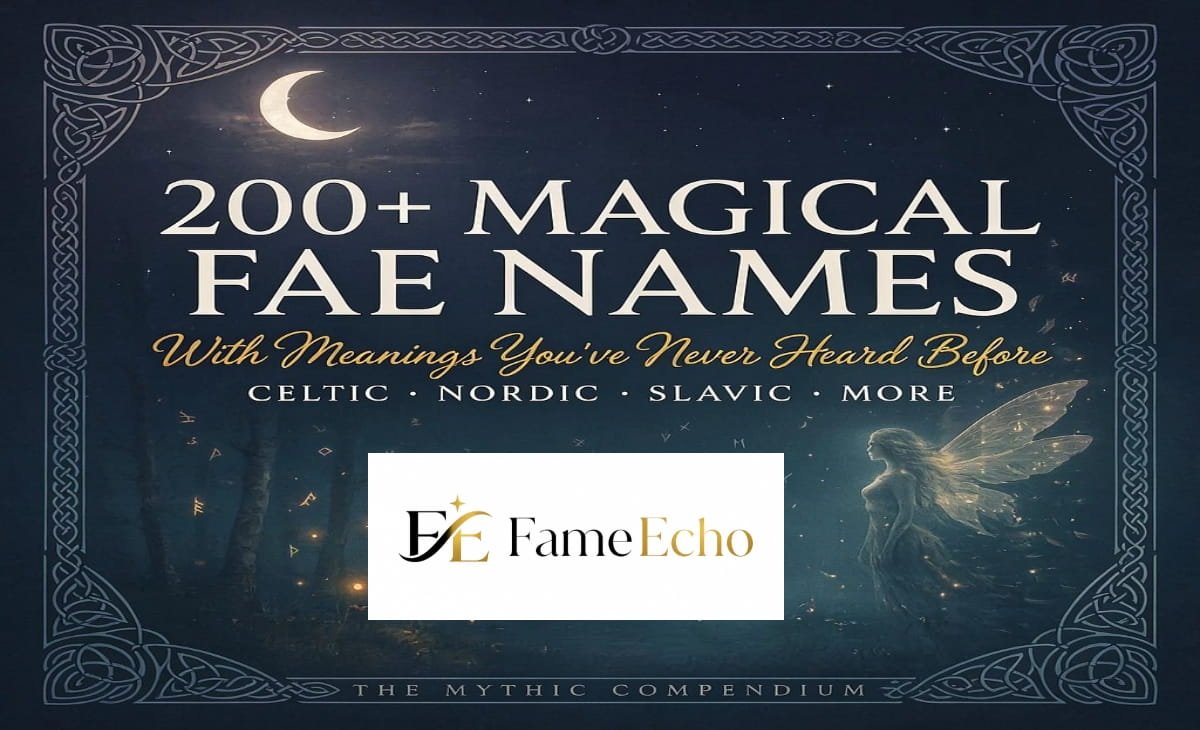

From the whispering forests of Celtic legend to the moonlit courts of Shakespearean drama, the fae have captivated human imagination for millennia. These otherworldly beings — elves, fairies, pixies, sprites, and countless creatures that populate the world just beyond our own — carry names as magical and layered as the beings themselves. Whether you are a writer crafting a fantasy world, a parent searching for a name with an ethereal quality, or simply a lover of folklore, the world of fae names is rich, beautiful, and endlessly fascinating.
Quick Fact Table: Fae Names at a Glance
| Feature | Details |
| Origin Languages | Old Irish, Welsh, Old Norse, Cornish, Latin |
| Most Famous Fae Name | Oberon (Shakespeare’s fairy king) |
| Oldest Known Fae Name | Puck (Old English / Old Norse origin) |
| Most Popular Modern Fae Name | Rowan, Briar, Elowen |
| Rarest Celtic Fae Name | Caer Ibormeith |
| Name Power Rule | Knowing a fae’s true name gives power over it |
| Best For | Fantasy writing, baby names, gaming characters |
What Makes a Name “Fae”?
Before diving into specific names, it helps to understand what gives a fae name its distinct character. Fae names across different cultures share several core qualities that set them apart from ordinary human names.
Musical Sound
Fae names tend to flow like water over stone. They feature soft consonants, lilting vowels, and syllables that feel almost sung rather than spoken. Names like Elowen, Sylvara, and Thessaly carry a quality that seems to shimmer in the air. Furthermore, these names rarely feel harsh or abrupt — even the darkest fae bears a name that sounds beautiful on the tongue.
Nature as a Source
The fae are intrinsically bound to the natural world. Their names often derive from trees, flowers, rivers, moons, seasons, and elements. A name like Briar or Rowan carries an immediate sense of wildness and rootedness. In addition, nature-derived names tend to carry dual meanings — a briar is both beautiful and thorned, much like the fae themselves.
Antiquity and Mystery
Many fae names draw from ancient languages — Old Irish, Welsh, Proto-Germanic, and Old Norse — giving them an air of timelessness. They sound like names that predate written history, names first whispered around firelight rather than written in books. Consequently, even invented fae names feel most convincing when they borrow phonemes and structures from these old tongues.
Duality
The fae are famously ambiguous beings, capable of great beauty and great danger in equal measure. Their names often reflect this duality — a name meaning “bright” may belong to a trickster; a name meaning “shadow” to a healer. This built-in contradiction is, therefore, one of the most distinctive features of fae naming traditions.
Celtic Fae Names
Celtic mythology is arguably the richest source of fae lore in the world. The Irish Tuatha Dé Danann, the Welsh Tylwyth Teg, and the Scottish fairy folk all provide a treasury of remarkable names. Moreover, Celtic fae names are unique because they come with complete mythological stories attached — each name is a doorway into legend.
Irish Fae Names and Their Meanings
Áine (AHN-yuh) — One of the most beloved names in Irish mythology, Áine is a fairy queen linked to summer, prosperity, and the sun. Her name means “brightness” or “radiance.” She rules over Cnoc Áine in County Limerick, and her light ripens the grain each harvest.
Niamh (NEEV) — Pronounced entirely unlike it looks, Niamh means “bright” or “lustrous.” In the legend of Oisín, she is a golden-haired fairy princess — in many versions identified as the daughter of sea god Manannán mac Lir, and in others as the daughter of the King of Tír na nÓg itself. She carries the hero to Tír na nÓg, the Land of Eternal Youth, on a white horse across the waves, where they live together for over three hundred years.
Clíodhna (KLEE-na) — A fairy queen of Munster, Clíodhna is linked to beauty and the sea. She keeps three magical birds whose singing heals the sick. Her name likely derives from an ancient word for “shapely” or “good form.”
Étaín (AY-teen) — One of the most famous figures in Irish mythology, Étaín was a fairy woman transformed by a jealous rival into a butterfly, then reborn as a human. Her name possibly means “jealousy” or “passion.”
Fionnuala (fin-OO-luh) — This beautiful name, sometimes shortened to Nuala, means “white shoulder.” Fionnuala is the daughter of sea god Lir, transformed with her brothers into swans for nine hundred years. Her story is one of patience, sorrow, and enduring love.
Welsh Fae Names and Their Meanings
Arawn — The ruler of Annwn, the Welsh Otherworld, Arawn’s name may mean “silver tongue” or connect to an ancient word for “king.” He is a figure of authority and mystery — not malevolent, but powerful and not to be crossed lightly.
Rhiannon — Perhaps the most famous of Welsh fairy names, Rhiannon links to horses, birds, and the Otherworld. Her name likely derives from an older Celtic form meaning “great queen” or “divine queen.” She rides a magical white horse that no one can overtake, no matter how fast they gallop.
Caer Ibormeith — A lesser-known but remarkable figure, Caer is a fairy woman who transforms into a swan every Samhain, spending alternate years in human and swan form. Her name translates roughly as “yew berry.” In one of Irish mythology’s most tender love stories, the god Aengus — deity of love, youth, and poetry — falls in love with her through recurring dreams. When he finally finds her among 150 swans at a lake, he transforms himself into a swan to recognize and claim her. Together they fly across Ireland, their song casting a magical sleep over the land for three days and nights.
English and Shakespearean Fae Names
English fairy tradition, particularly as shaped by literature from the medieval period through the Renaissance, gave us some of the most enduring fae names in the Western imagination. Shakespeare alone contributed names that writers and readers still reach for today.
Famous Fae Names from Shakespeare
Oberon — The king of the fairies in A Midsummer Night’s Dream, Oberon’s name traces back to the Old High German Alberich, meaning “elf ruler” or “power of the elves.” Before Shakespeare, he appeared in the French romance Huon of Bordeaux as a powerful fairy king. His name is, therefore, one of the oldest fae names in continuous literary use.
Titania — Shakespeare’s fairy queen takes her name from the Latin Titania, a title for the daughters of the Titans. It carries connotations of vast, ancient power. Titania is imperious, passionate, and formidable — and her name matches every one of those qualities.
Puck — One of the oldest names in English fairy lore, Puck (also known as Robin Goodfellow) is a shapeshifting trickster. His name may derive from an Old English or Old Norse word for a mischievous spirit. Over centuries, however, Puck shifted from threatening to playful — a shift that mirrors how human attitudes toward the fae changed over time.
Peaseblossom, Cobweb, Moth, and Mustardseed — Shakespeare’s fairy attendants in A Midsummer Night’s Dream bear names drawn entirely from the natural world. These names set a lasting template: tiny, delicate things from garden and hedgerow make perfect fae names for smaller, gentler fairy folk.
Arthurian Fae Names
Morgan le Fay — From Arthurian tradition, Morgan (sometimes Morgana) is a powerful enchantress whose epithet “le Fay” means “the fairy.” Her name Morgan may come from Welsh or Breton words meaning “sea-born” or “great queen.” She is one of literature’s most complex fae figures — healer, sorceress, antagonist, and guardian, often all at once.
Norse and Germanic Fae Names
The elves (álfar) of Norse mythology are the ancestors of many modern fae conceptions, and their names carry a cold, luminous beauty that mirrors the landscape of the far north. Additionally, Norse tradition divides its fairy-like beings into distinct categories, and each category has naming conventions of its own.
Ljósálfr — Not a personal name but a category: the Ljósálfar are the Light Elves of Norse mythology, beings of radiance who dwell in Álfheimr, one of the Nine Worlds. Their classification tells us something important — elven names link to brightness, light, and celestial beauty.
Alberich — The name of the dwarf-king in the Nibelungenlied, meaning “elf ruler.” Alberich is cunning, powerful, and dangerous. His name passed through Old French tradition and eventually gave us the fairy king Oberon — making Alberich the ancient grandfather of one of literature’s most famous fae names.
Andvari — A figure from Norse legend, Andvari is a dwarf who lives in a waterfall and transforms into a pike. His name may mean “careful one” or “the cautious.” This is, however, an ironic contrast to the catastrophic curse he places on the treasure stolen from him — caution did not save him from catastrophe.
Skuld — One of the three Norns, the fae-like weavers of fate in Norse mythology, Skuld’s name means “debt” or “that which should become,” representing the future. The Norns exist outside the fae tradition strictly speaking, but they share the essential fae quality of living beyond mortal comprehension.
Popular Fae Names for Characters and People
Whether for fiction writing, gaming, or simply choosing a name with otherworldly resonance, the following names are widely beloved in contemporary fae-inspired contexts. Moreover, many of these names work beautifully in the real world, for children or pen names, not just fictional characters.
Feminine Fae Names
Elowen — A Cornish name meaning “elm tree,” Elowen has the ethereal, nature-grounded quality perfect for a fae character. Soft and uncommon, it sounds like it belongs to a being who walks through ancient forests.
Sylvara — A constructed name from the Latin silva (forest), Sylvara has become a popular choice in fantasy writing for woodland fae. It evokes silver light filtering through leaves.
Thessaly — Borrowing from the Greek region linked to witchcraft and magic, Thessaly carries a powerful, intelligent quality. Furthermore, its three syllables give it a rhythmic weight that feels commanding.
Lyraen — Blending the musical instrument with a soft ending, Lyraen suggests a fae connected to song and sound, a creature whose voice charms or enchants all who hear it.
Seraphel — Merging the angelic seraph with an elvish suffix, Seraphel suggests a being of radiant, almost overwhelming beauty.
Morrigan — Taken from the Irish war goddess and fae figure, the Morrigan means “phantom queen” or “great queen.” This name carries weight and darkness alongside its beauty — a combination that makes it irresistible.
Caelia — From the Latin for “heaven” or “sky,” Caelia is airy and luminous. It suits a fae of the upper air, one who moves between clouds rather than through forests.
Masculine Fae Names
Caelan — An Irish name meaning “slender” or “narrow,” Caelan has a lean, quick quality. It suits a fast-moving trickster or scout of the fairy court.
Aldric — From Old High German meaning “noble ruler,” Aldric carries the authority befitting a fae lord or court elder.
Fenris — Though borrowed from the Norse wolf-figure, Fenris has become popular for darker, more ferocious fae — those of the wild hunt or the winter court.
Peregrin — Meaning “traveler” or “wanderer,” Peregrin suits a fae without fixed allegiance, one who crosses freely between worlds and owes loyalty to none.
Silvanus — The Roman god of forests lends his name to a fae archetype: ancient, deep, and deeply rooted in the natural world.
Taviel — A constructed name with an angelic suffix (-iel, “of God”), Taviel suggests a fae of formidable and slightly unnerving grace.
Gender-Neutral Fae Names
Rowan — The rowan tree was deeply magical in Celtic tradition, a protection against malevolent spirits. As a name, Rowan works beautifully for any fae character, in any tradition.
Briar — Thorned, wild, and beautiful, Briar is a perfect fae name — something lovely that can also wound. Consequently, it suits morally complex fae characters especially well.
Sage — Herb, color, and quality of wisdom all at once, Sage carries the quiet power of a fae who knows very old things.
Ash — One of the World Trees in Norse mythology, the ash is deeply sacred. As a name it is simple, strong, and ancient — three qualities that define the best fae names.
Lune — From the French and Latin for “moon,” Lune is luminous and changeable. It suits a trickster fae or a being of the night court perfectly.
The Rules of Fae Names in Folklore
One of the most important aspects of fae names in traditional folklore is not what they sound like, but what power they carry. In many traditions across cultures, knowing a faerie’s true name gives the knower power over it. This is precisely why the fae are notoriously reluctant to share their real names. They offer aliases or titles instead.
The True Name Tradition
The story of Rumpelstiltskin, though from German folklore rather than strictly Celtic tradition, illustrates this principle beautifully. The mysterious helper is destroyed the moment his true name is discovered and spoken aloud. Similarly, in many Irish tales, speaking the name of certain fairy beings could attract their dangerous attention unwillingly.
Names as Spiritual Power
This belief in the power of names is not unique to European tradition. Across world mythologies, the true name of a supernatural being is a form of spiritual leverage — a hook into the being’s very essence. It is why, in many fantasy traditions, fae characters go by titles (the Weaver, the Thornlord, the Lady of Silver) when dealing with mortals. Consequently, a fae who gives a mortal their true name is offering an enormous gift — and taking an enormous risk.
The Seelie and Unseelie Courts
Scottish fairy tradition divides the fae into two great courts — the Seelie Court (from the Scots word for “blessed” or “happy”) and the Unseelie Court (the unholy, darker court). Names belonging to Seelie fae tend to carry lighter, more musical qualities. Unseelie fae names are typically darker, harsher, or more ambiguous. This court distinction has become enormously influential in modern fantasy — Holly Black’s The Folk of the Air series, for example, builds its entire world around similar opposing courts. Understanding which court a fae belongs to is therefore one of the most useful frameworks for choosing a fae name, particularly for fiction writers.
The Sidhe and the Changeling Connection
The Sidhe (pronounced SHEE) are the fairy people of Irish mythology — beings who live within the fairy mounds scattered across the Irish landscape. Their names were closely guarded secrets partly because of the changeling tradition: the belief that fae could replace a human infant with a fairy substitute. Parents who knew the true names of local Sidhe were thought to have better protection against such exchanges. This is why fae naming lore is not merely poetic — in folk tradition, it was a matter of genuine spiritual safety.
Creating Your Own Fae Names
If you are writing fantasy fiction or building a world and want original fae names, several key principles will serve you well. Following these guidelines consistently produces names that feel genuinely magical rather than randomly invented.
Draw from Ancient Languages
Old Irish, Welsh, Old Norse, and Cornish all offer wonderful sounds that carry an authentic sense of age and otherworldliness. Even combining elements from these languages thoughtfully tends to produce names that feel genuinely fae. For example, blending an Irish prefix with a Welsh suffix often creates something that sounds ancient and unfamiliar without feeling made-up.
Favor Soft Sounds
The letters L, R, N, and S, combined with open vowels, create the flowing quality linked to fae speech. Hard stops (K, G, T, D) can work too, particularly for fiercer or darker fae characters, but use them intentionally rather than randomly.
Root Names in Nature
Trees, flowers, celestial bodies, weather phenomena, and seasons all make excellent fae name sources. A name like Wintrel or Hawthorn immediately places the character in the natural world. Furthermore, nature-names often carry built-in symbolic meaning, which adds depth to your characters without extra effort.
Consider the Court
In much modern fae fiction — inspired by works like Holly Black’s The Cruel Prince or Melissa Marr’s Wicked Lovely — fae divide into seasonal or elemental courts. A name should feel appropriate to its court. Crystalline and sharp names suit Winter Court fae; warm, flowering names suit Summer Court ones.
Let the Name Suggest the Character
The best fae names do double duty: they sound beautiful, and they tell you something about the being who bears them. Maleficent tells us something. Gloriana tells us something. Aim for that same loaded, layered quality in every name you create.
Conclusion
Fae names are far more than pretty sounds. They are vessels of mythology, ecology, and cultural memory — words that carry centuries of human wonder at the unknown edges of the world. Whether you are drawn to the ancient Irish names of fairy queens, the musical inventions of fantasy literature, or the simple beauty of nature-words elevated into titles, the world of fae names offers something genuinely extraordinary.
The best fae name is one that, when spoken aloud, makes the listener feel for a moment that the world might be a little larger, a little stranger, and a little more magical than it seemed before. That is, after all, what the fae have always done — and what their names continue to do.
Keep exploring with this helpful resource: 25+ Magical Names That Mean Dream — Beautiful, Rare & Deeply Meaningful Picks from Around the World
Frequently Asked Questions
What are the most popular fae names for fantasy characters?
The most popular fae names for fantasy characters include Rowan, Briar, Elowen, Niamh, Oberon, and Morrigan. These names strike the ideal balance between otherworldly sound and real mythological roots, making them feel authentic rather than invented. Writers frequently choose them because they carry built-in symbolic meaning from Celtic, Norse, or Shakespearean tradition.
What language do fae names come from?
Fae names come from several ancient languages, primarily Old Irish, Welsh, Old Norse, Cornish, and Latin. Celtic languages dominate the tradition because Ireland and Wales produced the richest fairy folklore in the world. Additionally, Shakespearean English and constructed fantasy languages have contributed many widely recognized fae names to modern use.
Is it bad luck to say a faerie’s true name?
In many folklore traditions — particularly Irish and Scottish — speaking a faerie’s name aloud could attract its unwanted attention. Furthermore, the belief held that knowing a fae’s true name gave power over it. This is why the fae in traditional stories prefer titles and aliases. Modern fantasy fiction, however, treats this more as a plot device than a literal superstition.
What are good gender-neutral fae names?
Excellent gender-neutral fae names include Rowan, Briar, Sage, Ash, Lune, and Wren. These names work because they root in nature rather than in gendered human naming conventions. The fae, in many traditions, exist outside human categories entirely — so nature-based names suit them especially well regardless of the character’s gender.
How do I create my own fake name?
To create your own name, start by combining elements from Old Irish, Welsh, or Old Norse. Then favor soft sounds (L, R, N, S) over hard stops, and root your name in something from nature — a tree, a celestial body, a season, or a weather phenomenon. Finally, make sure the name suggests something about the character who bears it. The best fae names always carry a second layer of meaning beneath their musical surface.
What is the difference between fae and fairy?
“Fae” and “fairy” are often used interchangeably today, but they carry slightly different tones. “Fairy” is the more common English term, often suggesting small, winged, benevolent creatures — the Tinkerbell archetype. “Fae,” by contrast, is a broader, older term rooted in Old French (faie, from Latin fata, meaning “fate”) that encompasses all supernatural beings of the fairy kind, including elves, sprites, pixies, and the powerful fairy courts. The fae are generally portrayed as more morally complex and dangerous than the soft modern image of the fairy. Most writers and mythologists use “fae” when they want to signal the full, ancient, morally ambiguous tradition.
What are good Seelie and Unseelie fae names?
For Seelie Court fae — the lighter, more benevolent fairy court of Scottish tradition — names like Caelia, Elowen, Niamh, Lyraen, and Rowan work beautifully, conveying brightness, nature, and grace. For Unseelie Court fae — the darker, more dangerous court — names like Morrigan, Fenris, Andvari, and Skuld carry appropriate weight and shadow. The key distinction is tone: Seelie names tend to feel open and melodic, while Unseelie names carry a harder edge or a sense of concealed danger beneath a beautiful surface.
