

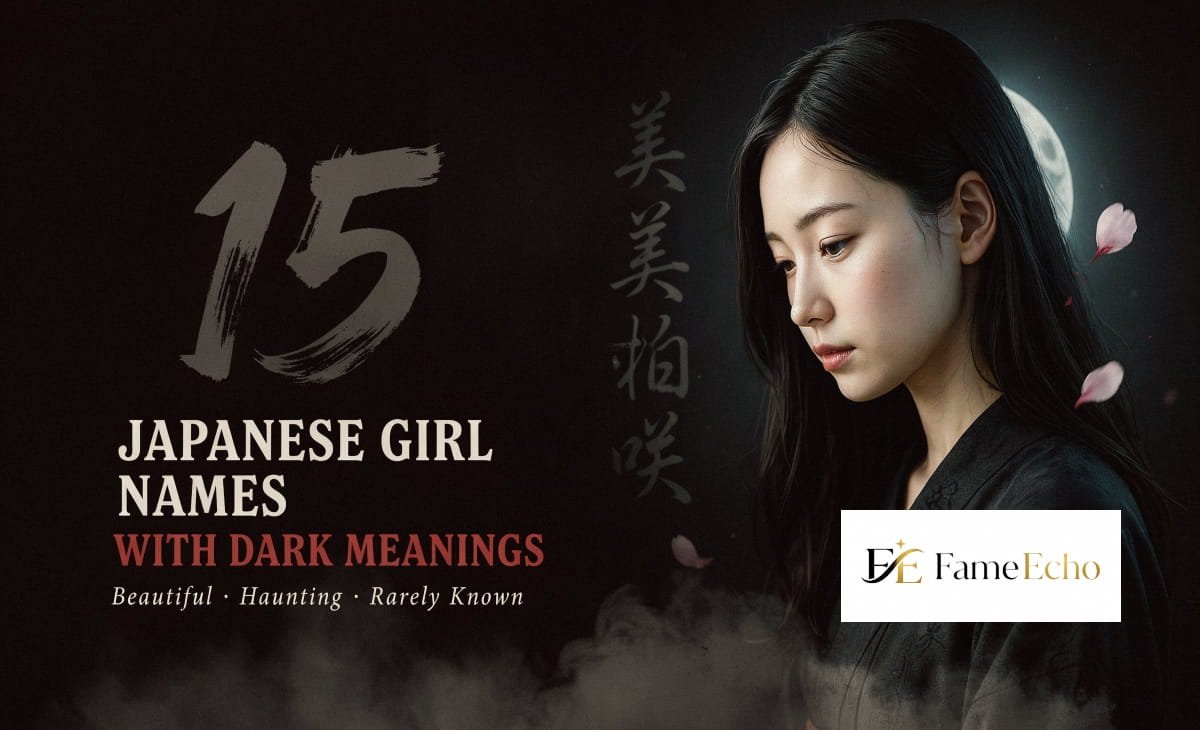

Japanese names carry deep, layered meanings. Most Western names are chosen for sound or tradition. Japanese names, by contrast, carry meaning at every stroke of their kanji characters. Furthermore, a single spoken name can use different kanji — and each version tells a completely different story.
Some of those stories are dark.
This guide explores Japanese girl names with dark meanings. Writers, world-builders, anime fans, and curious parents will all find something valuable here. Moreover, understanding these names reveals something profound: Japan has always found beauty in shadow, impermanence, and sorrow. These names are not shock value. Instead, they are windows into a culture that honors every corner of human experience — including the darkest ones.
Note: Kanji meanings in this article are verified against standard Japanese dictionaries including JMdict/EDICT and documented name databases. Cultural context draws on established Japanese aesthetic philosophy and folklore scholarship.
Why Do Japanese Girl Names Have Dark Meanings?
Japan holds a rich tradition of shadow aesthetics. Specifically, three cultural concepts explain why dark names exist and even hold beauty:
- Mono no aware — the bittersweet awareness of life’s impermanence
- Wabi-sabi — finding beauty in decay, imperfection, and transience
- Yūgen — a deep, mysterious sense of the universe that words cannot fully capture
Additionally, kanji characters are highly polysemous. The same spoken name can use different kanji to produce entirely different meanings. So a parent who writes one name with “moonlight” kanji tells one story. Another parent who writes the same sounds with “death” and “shadow” kanji tells something much darker.
Both names exist. Both are valid. That dual nature makes Japanese naming one of the most expressive systems in the world.
Japanese Girl Names With Dark or Mysterious Meanings
1. Yami — Darkness
Yami means “darkness” or “the dark.” It is direct and unapologetic. In everyday Japanese, yami describes both physical darkness and moral or spiritual shadow. The phrase yami no sekai means “the world of darkness.” As a name, Yami is rare in real life. However, it appears frequently in anime, manga, and dark fiction as a name for powerful, mysterious female characters.
2. Noroi — Curse
Noroi means “curse” or “hex.” It derives from the verb norou, which means to curse another person. Curses in Japanese folklore carry serious weight. They tie to unresolved grief, deep rage, or injustice left unpunished. Therefore, a character named Noroi carries supernatural, ancient power. She is not simply dark — she is wronged, and she remembers.
3. Shi — Death or Poetry
Shi is one of the most striking examples of kanji duality. Written as 死, it means “death.” Written as 詩, the same sound means “poem.” Because of the death meaning, the number four (shi) is avoided in many Japanese hospitals and elevators. A girl named Shi with the death kanji would be deeply unconventional — reserved almost entirely for fiction. However, with the poetry kanji, the name becomes elegant and entirely usable.
4. Kurai — Gloomy
Kurai means “dark” or “gloomy.” As a name, it does not suggest pure evil. Instead, it evokes an introspective, brooding quality. In daily Japanese speech, kurai describes a dim room or a withdrawn personality. As a character name, Kurai suits someone quiet, observant, and deeply internal — a girl who sees everything but says little.
5. Akumu — Nightmare
Akumu translates literally to “evil dream.” Two kanji form it: 悪 (aku, evil or bad) and 夢 (yume, dream). Real parents do not use this name. Nevertheless, in fiction it holds tremendous power. A character named Akumu exists between waking life and terror. She haunts. She unsettles, also she arrives where she is least expected.
6. Yūrei — Ghost
Yūrei is the Japanese word for “ghost” or “spirit.” The first kanji, 幽 (yū), means something faint, hidden, or dim. The second, 霊 (rei), means spirit or soul. Together, they name a specific kind of ghost — usually a woman with unresolved emotional pain who cannot move on. Japanese ghost stories are among the most psychologically rich in world literature. Consequently, the name Yūrei carries grief, longing, and a haunting presence that outlasts death.
7. Kuroi — Black
Kuroi means “black” or “dark-colored.” Black in Japanese culture is not purely negative. It also signals formality, strength, and elegance. Nevertheless, as a girl’s name, Kuroi has an unmistakably shadowy edge. It works especially well for a character who is powerful, controlled, and dangerous beneath a composed exterior.
8. Yamiko — Child of Darkness
Yamiko combines 闇 (yami, darkness) with 子 (ko, child). The -ko suffix was extremely common in 20th-century Japanese girl names — think Keiko, Yūko, Hiroko. Yamiko twists this familiar pattern into something darker. Literally, she is “the child of darkness.” As a result, the name feels both culturally grounded and deeply ominous.
9. Meiku — Underworld Suffering
Meiku is one of the rarest names on this list. Written with 冥 (mei, the realm of the dead or hidden darkness) and 苦 (ku, pain or suffering), it means “suffering in the underworld.” Clearly, no modern parent would register this name. However, in myth, folklore, and dark fantasy, Meiku names a girl marked by suffering — one who has descended to the lowest places and survived.
10. Tsukikage — Shadow of the Moon
Tsukikage means “moonlight” or literally “shadow of the moon.” The moon in Japanese culture links to loneliness, transformation, and the supernatural. Yokai and spirits traditionally emerge under moonlight. Thus, a girl named Tsukikage is the shadow moonlight casts — ethereal, fleeting, and not entirely of this world. Notably, this name carries a dark meaning while remaining genuinely beautiful.
11. Reimei — Dawn at the Edge of Darkness
Reimei (黎明) means “daybreak” or “dawn” — literally the thin boundary where darkness ends and light has not yet fully arrived. The first kanji, 黎, carries a secondary meaning of “dark” or “black” alongside its primary meaning of “many.” The second, 明, means “bright” or “light.” Together, Reimei names a moment that is neither dark nor fully bright — a liminal space that makes it one of the most atmospheric names on this list. A girl named Reimei exists at the threshold: she has come through darkness, but the light has not yet claimed her fully. This makes her an ideal name for a survivor, a prophetess, or a tragic heroine who carries both worlds inside her.
12. Akuko — Evil Child
Akuko combines 悪 (aku, evil) with 子 (ko, child). The meaning is blunt: “evil child” or “wicked child.” No modern Japanese parent would use this name officially. However, in folklore and dark fiction, Akuko names a child born under an ill omen — one whom the village fears, one who grows into exactly what others always believed she would become. There is genuine tragedy in that arc.
13. Shiyo — Generation of Death
Shiyo combines shi (death, 死) with yo (generation, era, or world, 代). Together, the name evokes “the generation of death” or “the age of death.” In stories set during plague, war, or apocalyptic collapse, Shiyo names a girl who has seen the entire world’s end. Furthermore, the name is poetic rather than cartoonishly dark — she carries loss, not malice.
14. Kurami — Dark Beauty
Kurami pairs 暗 (kura, dark or gloomy) with 美 (mi, beauty). The result is “dark beauty” — a name that doesn’t hide its contradiction. It belongs to a girl whose beauty is inseparable from her shadow, whose attractiveness unsettles rather than reassures. While the common name Kurumi (胡桃, walnut) is warm and botanical, Kurami written as 暗美 takes the same melodic shape and pulls it toward something more complex. It is documented in Japanese name databases as a rare but valid feminine name, making it one of the more usable dark names on this list for real-world or creative purposes.
15. Kage — Shadow
Kage simply means “shadow.” It appears in many compound names and carries a rich meaning in Japanese aesthetics. In the classic essay In’ei Raisan (“In Praise of Shadows”), writer Jun’ichirō Tanizaki argued that beauty in Japan lives in shadow rather than direct light. Therefore, a girl named Kage is not merely dark — she is where beauty actually lives.
The Cultural Philosophy Behind These Names
What separates these names from simple shock value is the philosophy beneath them. Japan’s artistic traditions — from Heian poetry and Noh theater to contemporary horror manga — have long treated darkness as the necessary partner of light.
The Buddhist concept of mujō (impermanence) teaches that nothing lasts forever. Beauty sharpens because it fades. Death gives life meaning because it has a boundary. Consequently, a name tied to shadow, curse, or death does not celebrate evil. Rather, it acknowledges that these forces exist, that they shape us, and that some people live closer to that edge than others.
In fiction, these names do extraordinary work. They assign weight and gravity before a single line of dialogue. A character named Noroi does not need to explain her darkness — the name already tells the reader everything.
Practical Uses for These Names
For fiction writers and world-builders: Names like Noroi, Akumu, and Yūrei instantly communicate history, power, and menace. Use them for antagonists, tragic heroines, or supernatural characters in Japanese or Japanese-inspired settings.
For anime and manga fans: Many of these names already appear in beloved series. Knowing their meanings deepens your understanding of character design and writer intent.
For parents seeking something unconventional: Names like Tsukikage or Kage carry dark meaning while sounding genuinely beautiful. In international contexts, their dark undertones remain subtle — heard first as melodic and unusual.
For language learners: Each name here is a lesson in kanji, cultural philosophy, and the expressive range of Japanese. Moreover, studying names is one of the most engaging ways to build vocabulary.
Conclusion
Japanese girl names with dark meanings sit at a fascinating crossroads of language, spirituality, aesthetics, and storytelling. They are not names chosen carelessly. Instead, they reflect a culture that has always taken shadow seriously — that has found poetry in grief, elegance in impermanence, and meaning in the places most cultures refuse to look.
From the blunt power of Yami (darkness) to the ethereal beauty of Tsukikage (shadow of the moon), each name on this list carries a world inside it. Whether you need a name for a character, a creative project, or simply want to understand Japanese culture more deeply, these names reward close attention.
In Japan, even darkness deserves a beautiful name.
You might also be interested in this article: From Blush to Barbie: 60+ Gorgeous Names for Pink That Will Change How You See Color Forever
Frequently Asked Questions
Are Japanese girl names with dark meanings actually used in real life?
Most of the darkest names — such as Akumu (nightmare) or Noroi (curse) — are not used in real Japanese birth registries. However, names like Kage (shadow) or Tsukikage (shadow of the moon) are unusual but plausible. Dark-meaning names appear most often in fiction, anime, manga, and creative writing.
What is the most common Japanese name meaning darkness?
Yami is the most direct Japanese word and name meaning “darkness.” It is rarely used as a real given name due to its stark connotation. However, it is one of the most recognized dark names in anime and manga culture.
Can kanji change the meaning of a Japanese name completely?
Yes. This is one of the most distinctive features of Japanese naming. The same spoken name can use entirely different kanji to produce opposite meanings. For example, Shi can mean “death” (死) or “poetry” (詩) — the same sound, two completely different identities.
Why does Japanese culture associate beauty with dark or sad themes?
Japanese aesthetics include concepts like mono no aware (beauty in transience), wabi-sabi (beauty in imperfection), and yūgen (deep, mysterious beauty). These philosophies teach that darkness is not the opposite of beauty — it is part of what makes beauty meaningful. Therefore, names tied to shadow, death, or sorrow can carry genuine elegance.
Are these names appropriate for fictional characters outside of Japanese settings?
Absolutely. Many fiction writers, game developers, and anime creators worldwide use Japanese dark-meaning names for characters in fantasy, horror, and science fiction settings. Using them respectfully — with awareness of their cultural origins — adds authenticity and depth to any creative work.
Is using Japanese names for non-Japanese characters considered cultural appropriation?
This is a nuanced question. Using Japanese names in creative fiction — especially in fantasy, horror, or world-building — is generally acceptable when done with genuine research and respect. Problematic use tends to involve treating names as exotic decoration without understanding their meaning. Learning what a name means, as this article helps you do, is precisely the kind of respectful engagement that crosses from appropriation into appreciation. For real-life baby naming, many Japanese-language name resources note that non-Japanese parents using Japanese names is increasingly common and broadly accepted, provided the name is chosen thoughtfully.
